Knee pain can quickly interfere with running, training, and competition—but the location of the pain alone does not always reveal the cause.
The knee is influenced by the mobility, strength, and control of the entire lower extremity. A meaningful evaluation should consider not only the painful area, but also the hip, ankle, foot, training demands, and how the athlete moves.
Here are several common causes of knee pain in runners and athletes.
1. Patellofemoral Pain
Patellofemoral pain is commonly called “runner’s knee.” It generally produces pain in the front of the knee or around the kneecap.
Symptoms may worsen with:
-
Running
-
Squatting or jumping
-
Walking up or down stairs
-
Sitting with the knee bent for an extended period
-
A sudden increase in training volume or intensity
Contributing factors can include training errors, changes in footwear or playing surface, and reduced strength or control in the quadriceps and hip muscles. The American Academy of Orthopaedic Surgeons notes that several different factors may contribute, so treatment should be individualized.
2. Patellar Tendon Irritation
The patellar tendon connects the kneecap to the shinbone. Repeated running, sprinting, and jumping can overload this tendon, producing pain directly below the kneecap.
Athletes may notice pain during jumping, accelerating, decelerating or rising from a squat. Tendon problems usually require progressive loading—not simply prolonged rest—after the injury has been properly evaluated.
3. Iliotibial Band–Related Pain
Pain on the outside of a runner’s knee is frequently associated with irritation involving the iliotibial band and surrounding tissues.
It may begin after a predictable amount of running and become more noticeable with downhill running or repeated bending and straightening of the knee. Training volume, running mechanics, hip control, and recovery should all be considered.
4. Meniscus Injury
The menisci are cartilage structures that help distribute load and stabilize the knee. A meniscus can be injured during twisting, pivoting, or deep knee bending, although symptoms may also develop gradually.
Possible signs include:
-
Pain along the knee’s joint line
-
Swelling or stiffness
-
Painful catching or locking
-
Difficulty fully bending or straightening the knee
-
A sensation that the knee is giving way
The American Academy of Orthopaedic Surgeons identifies pain, swelling, locking, instability, and reduced range of motion among the common symptoms of a meniscus tear.
5. Ligament Sprain
Sports involving contact, cutting, or rapid changes of direction place greater stress on the knee’s ligaments.
A ligament injury may involve a pop, rapid swelling, or a feeling that the knee is unstable. These injuries should be examined promptly—especially when the athlete cannot continue playing or does not trust the knee to support them.
6. Bursitis or Other Soft-Tissue Irritation
The knee contains several bursae that help reduce friction. Repetition or direct pressure can irritate these tissues.
For example, pes anserine bursitis can cause tenderness on the inside of the leg just below the knee. Running hills, rapid mileage increases, and hamstring tightness may contribute. Its symptoms can resemble those of a meniscus injury, ligament sprain, or stress injury, making an examination important.
7. Joint Irritation or Arthritis
Not all athletic knee pain is a new sports injury. Previous trauma, cartilage changes and arthritis can create stiffness, swelling, reduced motion or pain that increases with activity.
The goal is not necessarily to stop exercising. It is to identify what the knee can currently tolerate and develop a safe plan to improve mobility, strength and capacity.
The Painful Area May Not Be the Whole Problem
Knee symptoms may be influenced by:
-
Hip weakness or reduced control
-
Restricted ankle movement
-
Foot mechanics
-
Muscle-strength or mobility imbalances
-
Running and landing mechanics
-
Training errors
-
Inadequate recovery
That is why treating only the painful spot may not produce lasting improvement.
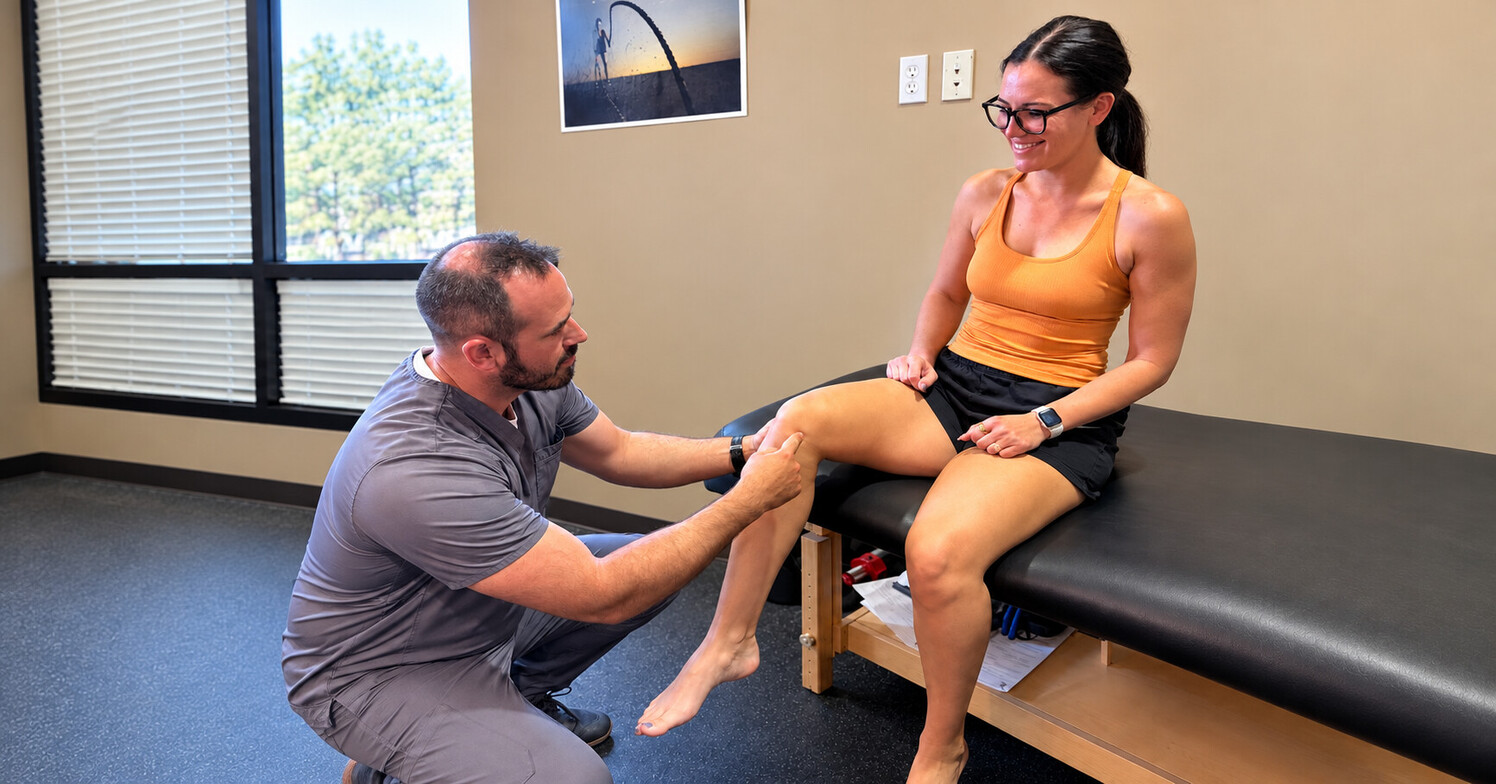
At Better Chiropractic, Dr. Brennan Bates and Dr. Will Curtis evaluate the knee as part of the entire movement system. Depending on the findings, care may include manual treatment, mobility work, progressive rehabilitation, corrective exercise, and recommendations for modifying activity.
If the examination suggests a fracture, significant ligament injury, meniscus injury or another condition requiring imaging or specialty care, an appropriate referral can be made.
When Should Knee Pain Be Evaluated?
Schedule an evaluation when pain:
-
Persists or repeatedly returns
-
Changes your running mechanics
-
Limits training or normal daily activities
-
Is accompanied by recurrent swelling
-
Produces painful clicking, catching, or instability
-
Does not improve after reducing the aggravating activity
Seek prompt medical attention following significant trauma, or when the knee is visibly deformed, rapidly swelling, unable to bear weight, truly locked, hot and red with fever, or associated with considerable calf swelling.
Don’t Just Push Through It
Knee pain does not automatically mean that an athlete must stop doing what they love. But repeatedly training through pain without understanding its cause can allow a manageable problem to become more limiting.
A thorough evaluation can help determine which structures are involved, what contributed to the problem, and what the athlete needs to return safely and confidently.
Experiencing knee pain while running or playing sports? Schedule an evaluation with Better Chiropractic in Gilbert, Arizona.
This article provides general educational information and is not a diagnosis or a substitute for individualized medical care.
Sources