Ankle pain after sports is often called a sprain, but symptoms alone cannot confirm which structure is injured. Ligaments, tendons, bones, cartilage and the joints of the ankle and foot can produce overlapping pain, swelling and difficulty walking.
If the ankle remains painful, repeatedly gives way, stays swollen or changes the way you run, jump or walk, a thorough evaluation can help determine what was injured and what needs to happen before you safely return to activity.
Could It Be an Ankle Sprain?
An ankle sprain occurs when one or more ligaments are stretched or torn. The most common pattern happens when the foot rolls inward and stresses the ligaments on the outside of the ankle.
Possible symptoms include:
- Pain with walking, running or changing direction
- Swelling or bruising
- Tenderness near the injured ligaments
- Loss of motion
- A feeling that the ankle is unstable or may give way
The severity can range from microscopic ligament damage to a complete tear. A severe sprain can look and feel similar to a fracture, so the amount of bruising or swelling does not establish the diagnosis by itself.
Could a Tendon Be Involved?
Tendons connect muscle to bone and help control the foot and ankle during running, jumping, landing and cutting.
Depending on the location and mechanism of the injury, pain may involve structures such as the peroneal tendons along the outside of the ankle, the posterior tibial tendon on the inside, or the Achilles tendon at the back of the ankle.
Tendon-related symptoms may include pain with resisted movement, loading, pushing off, hopping or repeated activity. Some tendon problems develop after a clear injury; others build gradually after changes in training volume, surface, footwear or recovery.
Because tendon and ligament symptoms can overlap, pain location is a useful clue—not a complete diagnosis.
When Could It Be a Fracture or Stress Injury?
A fracture should be considered after a significant injury, especially when there is focal tenderness over a bone or the athlete cannot bear weight. The American College of Radiology identifies inability to walk four steps and point tenderness over specific ankle bones among the findings clinicians use when deciding whether an X-ray is appropriate after acute trauma.
Stress injuries are different. They can develop gradually when repeated loading exceeds the bone’s ability to recover. Pain may become more predictable with running or jumping and may progress from activity-related discomfort to pain during ordinary walking.
Early stress fractures do not always appear on an initial X-ray. The history, examination and location of the suspected injury help determine whether additional imaging or referral is needed.
What Does a Complete Ankle Evaluation Include?
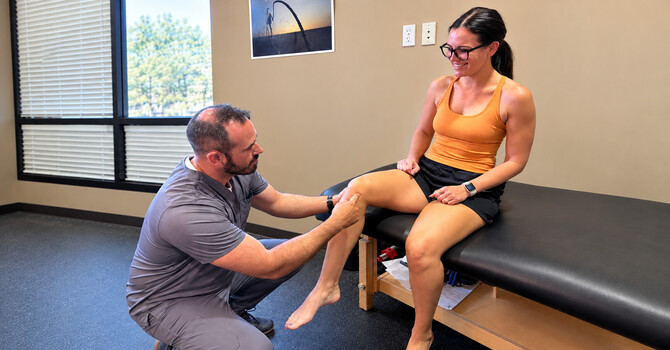
An ankle examination should look beyond the painful spot. Depending on the situation, Dr. Brennan Bates or Dr. Will Curtis may evaluate:
- How the injury occurred
- The location and pattern of pain
- Swelling, bruising and ability to bear weight
- Tenderness over ligaments, tendons and bones
- Ankle and foot mobility
- Strength and stability
- Balance and movement control
- Walking, running, landing or cutting mechanics
- Previous ankle injuries and the demands of the patient’s sport
Single-leg balance, hopping or sport-specific testing may be useful later in the evaluation or rehabilitation process, but only when it is appropriate and safe for the injury.
Do You Need an X-Ray or MRI?
Not every ankle injury requires imaging.
An X-ray is commonly used when examination findings raise concern for a fracture. An MRI is not routinely required to diagnose a typical ankle sprain, but it may be considered when the examination suggests injury to tendons, cartilage, the high-ankle structures or another soft tissue—or when symptoms persist despite appropriate care.
The purpose of imaging is to answer a clinical question and help guide management, not simply to order every available test.
What Should Return to Sport Be Based On?
Feeling less pain is important, but it is not the only consideration.
An international sports-medicine consensus recommends considering five areas after an acute lateral ankle sprain:
- Pain during sport and over the previous 24 hours
- Ankle motion, strength, endurance and power
- The athlete’s confidence, sense of stability and psychological readiness
- Balance and movement control
- Functional performance, including hopping, jumping, agility, sport-specific drills and the ability to complete a full training session
The appropriate progression depends on the injury, the athlete and the demands of the sport. A soccer player, runner, basketball player and recreational lifter may not need the same testing or rehabilitation plan.
When Should Ankle Pain Be Evaluated Promptly?
Seek prompt medical evaluation when an injury includes:
- Visible deformity or an open wound
- A foot that becomes numb, pale, blue or unusually cold
- Inability to bear weight or walk four steps after the injury
- Significant point tenderness over the ankle or foot bones
- Rapid swelling, severe pain or worsening symptoms
- A suspected Achilles rupture
- Persistent pain, swelling or instability that is not improving
When symptoms are recurring rather than sudden, an evaluation is also appropriate if the ankle repeatedly gives way, alters movement or prevents a full return to sport.
An Individualized Sports-Injury Plan in Gilbert, Arizona
At Better Chiropractic, the goal is to identify what is contributing to the problem and match care to the examination findings and activity demands.
When appropriate, a plan may include hands-on care, mobility work, progressive strengthening, balance and movement training, activity modification and a return-to-sport progression. If the findings suggest a fracture, significant tendon injury, unstable high-ankle sprain or another condition requiring imaging or specialty care, we will recommend the appropriate referral.
Dealing with ankle pain after sports? Schedule a sports injury evaluation with Better Chiropractic in Gilbert, Arizona.
This article provides general educational information and is not a diagnosis or a substitute for individualized medical care.
Suggested FAQs
How can I tell whether my ankle is sprained or broken?
Sprains and fractures can both cause pain, swelling, bruising and difficulty walking. The injury mechanism, ability to bear weight and location of bone tenderness help guide the examination, but imaging may be required when a fracture is suspected.
Should I get an MRI for an ankle sprain?
Not routinely. Most ankle sprains are diagnosed from the history and examination. MRI may be considered when another soft-tissue or cartilage injury is suspected, a high-ankle injury is possible, or symptoms persist despite appropriate care.
When can I return to sports after an ankle sprain?
Return should be based on more than time or pain alone. Motion, strength, balance, confidence, hopping or agility, sport-specific performance and tolerance of a full practice may all matter.
Why does my ankle keep giving way?
Repeated giving way may reflect incomplete rehabilitation, reduced strength or balance, ligament laxity, movement-control deficits or another unresolved injury. An examination can help identify the contributing factors.